
Cracking the ‘WIP’
by Stephane McShane
An accurate work-in-progress forecast is a key indicator of the financial aptitude of your organization. Banks and bonding companies rely on your work-inprogress report as an important barometer to establish their confidence in your company. What do your forecasts say about your company? Are the forecasts delivering the type of financial predictability that your bank and bonding company and others may need? If forecasts are a challenge, there are steps you can take to improve the work-in-progress process.
The structure of a strong workin-progress process begins with system setup. Proper system setup will allow for accurate collection of time and quantities installed in order to calculate earned value. Use of earned value calculations will allow for accurate forecasting of the cost at completion for individual projects. Accurate forecasting translates into
IN THIS ARTICLE . . .
• An accurate WIP forecast is an indicator of your firm’s financial aptitude.
• Do your WIP forecasts deliver the financial predictability your advisors need?
• Four steps for improving your work-in-progress process.
predictability in the WIP and, therefore, confidence in the financial reporting within the organization.
Part 1: System Setup
The foundation of a strong WIP process begins with proper system setup inside of the accounting software. The setup is composed of cost types and cost codes that will allow for ease of field reporting, while still collecting various information needed to properly evaluate performance. The cost type and cost code structure can be best described in Exhibit A.
Exhibit A
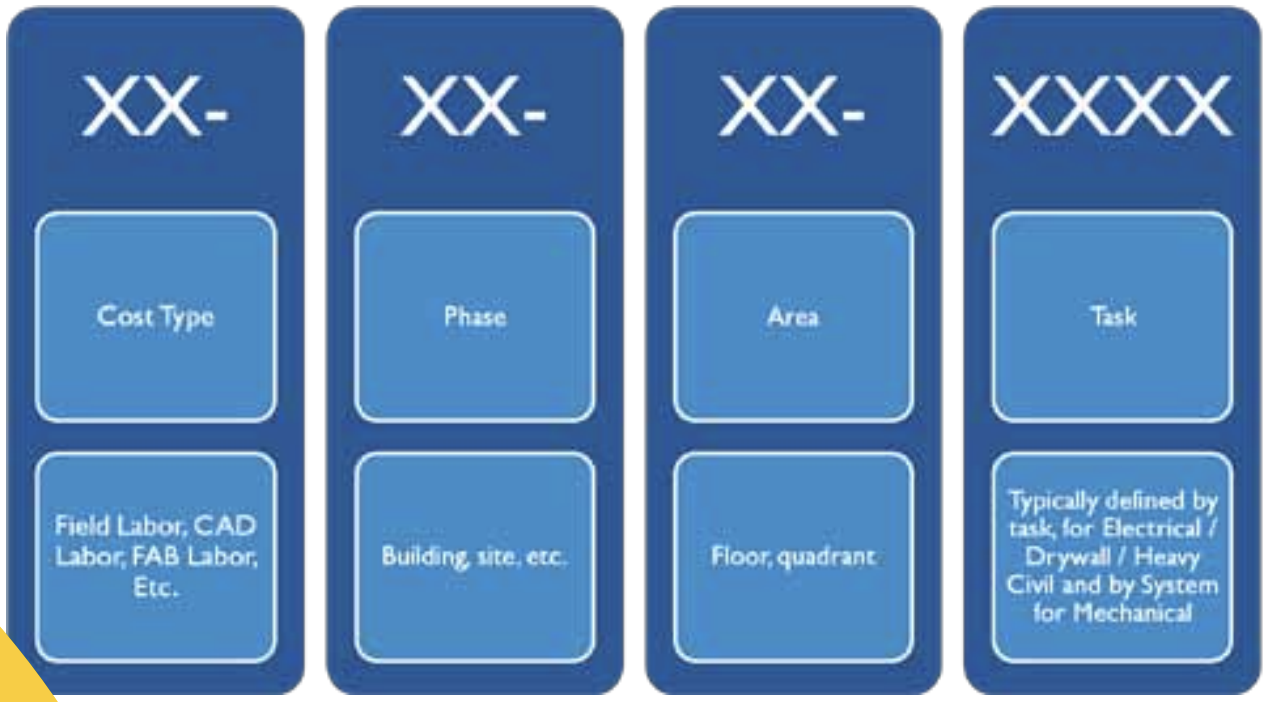
The number of digits allowable and their sort capability are dependent upon the system restrictions of your accounting software. However, these four levels are necessary for the majority of self-performing contractors to accurately track
job cost. The levels, from broad to specific, are cost type, phase, area and task. These levels allow for the sorting of information in meaningful ways to evaluate the performance of a project at any given snapshot of time. The cost type field allows for the separation of design/engineering labor, prefabrication labor, and field labor along with material, subcontractors, equipment, and “other” direct job costs.
The separation of this data allows for the costs to be evaluated independently, and can also be combined to give a clear picture of a total installed cost. This is especially important to those firms that have design staff and/
or prefabrication facilities in order to quantify the savings that these operations afford the contractor. The phase and area codes are userdefined fields and are customized individually to fit the project.
The phase, for example, can be used to break the project into separate buildings and a site. The area could be used to define the floors or quadrants within a building or on a site. It is important that the phases and areas The number of digits allowable and their sort capability are dependent upon the system restrictions of your accounting software. However, these four levels are necessary for the majority of self-performing contractors to accurately track
M A R C H 2 0 1 4 T H E C O N T R A C T O R ’ S C O M P A S S
Is Your Company Prepared for the Economic Recovery? Find Out in ASA’s April 8 Webinar
Coming out of this economic downturn, is your company financially positioned to lead the charge — or watch from behind? In the April 8, 2014, ASA webinar, “Strategic Planning: Looking Forward from the Downturn,” presenter Stephane McShane, Maxim Consulting Group, Denver, Colo., will discuss the steps to building a comprehensive and effective strategic plan, including the supporting organizational development initiatives, such as work-in-progress processes, and how the plan links with the business development efforts of your firm.
“To succeed in the rebounding economy, organizations must understand the outcomes they want to achieve and steps it will take to get there,” McShane said. “Today, financial strength is a critical component of a strategic plan, as bonding capacities are at all-time highs and contractors are stretching resources to respond to potential work.”
This live, 90-minute webinar will begin at 12:00 p.m. ET/9:00 a.m. PT. The registration fee is $99 for members and $179 for nonmembers and allows access with one Internet connection. Project the webinar onto a screen or wall and listen to it on a speakerphone for a group training event. After the program, registrants will receive a link to a recording of the webinar, and an ASA Certificate of Completion that can be downloaded and printed for each person who watched. Register online.
make sense from a field perspective and are simple to differentiate from one another.
Task codes are standardized throughout an organization. Two pitfalls to avoid when defining task codes are making them far too complex or making far too many task codes. Task codes must be clear enough to be easily understood by field staff. The field staff will be responsible for accurately reporting time and quantities according to these task codes. Dividing a project budget up using more phases and areas and fewer cost codes is simpler for the field staff to interpret, and the critical information collected is more accurate.
Once you build the foundation of cost codes, you can create an accurate project budget. The budget should be formulated in a way that facilitates the ease of tracking production on the project. When formulating the budget, no single cost code should contain more than 5 percent of the total labor hours of a project. This is done so that no single bucket of labor is so large that it becomes difficult to evaluate and forecast. This drives the accuracy of the forecasting process.
Part 2: Use of Earned Value
In many organizations, the evaluation of the percent complete on any given project is an educated guess. When you use these guesses to formulate a cost at completion, the data becomes even more unreliable. The use of earned value transitions the forecasting process from a management by “gut” philosophy to one based on past performance and mathematics.
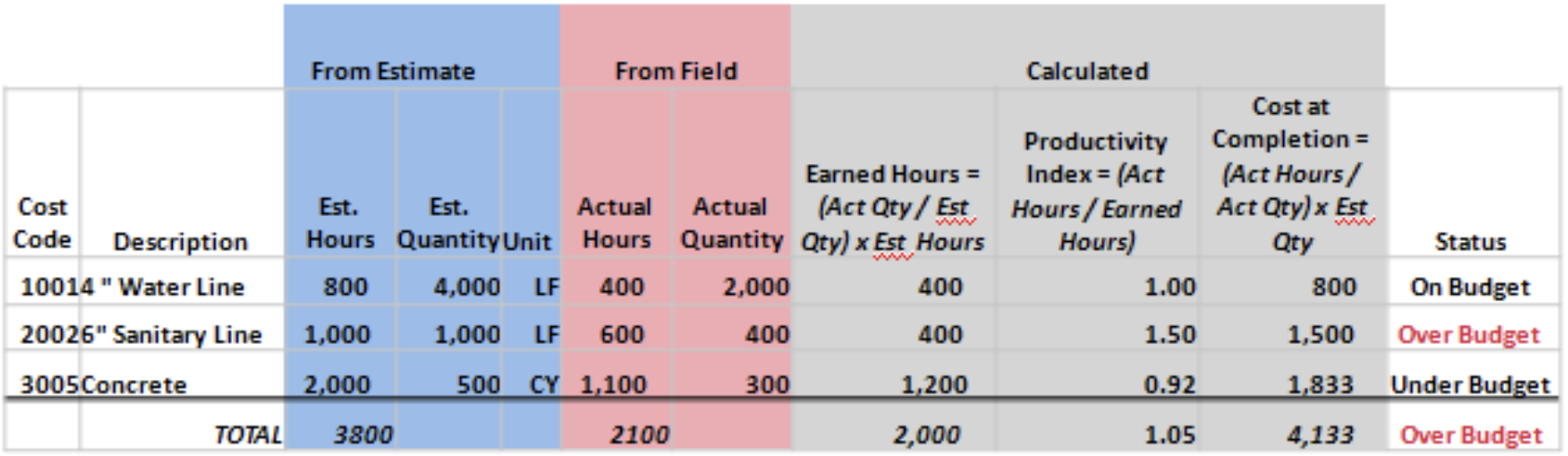
In the forecasting process, forecasting of labor is the greatest challenge. Using earned hours calculations will enable you to define how many hours should be spent installing a specific quantity of product compared to what was actually spent. The effective use of earned hours requires the reporting of labor hours and quantities installed by the budgeted line items. If you know the amount of time spent on an activity along with the progress
of that activity, you can calculate the amount of “earned hours” or the amount of hours that should have been spent to install those quantities according to the budget.
Real-time feedback on labor productivity is also possible when you use earned hours. By identifying labor fades early enough, you have time to alter final outcomes. Using this method, generating field-friendly data to effectively communicate labor performance monthly, weekly, or even daily is possible. With the availability of comprehensive construction accounting software packages, collecting and translating this
Exhibit B
Billing, like Schedule of Values’ creation, should be a standard process with specific, measurable goals.
information has become increasingly simple.
Looking at the information contained in Exhibit 2, the status of any given cost code and, therefore, the entire project, can be evaluated quickly and easily. With the first two pieces of the foundation built, the system setup and earned hours, you are now ready to tackle the actual forecasting process.
Part 3: Forecasting
Your company’s ability to accurately predict the outcome of a project defines the financial acumen of your organization. There are seven steps to producing an accurate project forecast:
T H E C O N T R A C T O R ’ S C O M P A S S M A R C H 2 0 1 4

1. Verify the contract value by comparing the system-generated value from your accounting software with the latest billing to ensure consistency.
2.Verify the status of all internal and external change orders. This verification includes having a clear understanding of which change orders have had costs recognized, and which have had costs and revenue recognized, and which have been fully approved, recognizing cost, revenue, and have been billed.
3.Verify the earned value reporting. This is done by verifying that the quantities or percent complete that the field has reported for each labor line item is correct and adjusting as needed to bring this in line. Then, the labor cost to complete is easily calculated. Since this is based on mathematics and the past performance of any given line item, adjustments to the labor cost to complete should be minimal.
4.Forecast the other job costs such as materials, subcontracts, equipment, and “other” direct job costs.
5.Run a forecasting diagnostic
tool, such as a traffic light report, to flag inconsistencies in the forecast, thus driving quality into the forecast. Typical inconsistencies that would be identified might include: incurred cost is greater than the forecast, incurred cost is greater than the revised budget, forecast is greater than the revised budget, committed cost is greater than revised budget, forecast is greater than committed cost, and committed cost is greater than forecasted cost.
6.Liquidate any open commitments that will not be utilized.
7. Thoroughly review the job status report to ensure all values are correct. An effective job status report should have sections that give detail on the contract value, schedule data, cash position, forecast, and metrics to identify areas of concern.
Part 4: WIP
Similar to forecasting, running the work-in-progress review should be a consistent, standardized process. The review of projects should be done monthly or more often if a project is a challenge. The dates for WIP reviews should be
published for the year so that all project staff members are aware of when they are occurring. Using a WIP review checklist will ensure that the proper information and reports have been reviewed and the right questions are asked. There should be a standardized attendance list for the meeting, as well as an escalation process if a project is found to be at risk. A running log of issues, cost challenges, and margin gain should be kept to track the progression of the project month to month.
World-class firms have the financial aptitude to thoroughly understand the WIP process and why it is so critical to the financial health of the organization. They have empowered their staff to effectively manage each step of the process. They have the discipline to stick to the defined standards and hold their project management staff accountable for the WIP process and the financial outcomes of their projects. These firms have provided transparency and predictability in the financial position of their projects. More importantly, they will know, with a high degree of accuracy, how much will be gained or lost by a project. When accurate financial controls are coupled with the technology, tools, training, and incentives to drive the desired behaviors with your staff, you are close to defining what best-in-class is for your own organization.
Stephane McShane is an associate director with Maxim Consulting Group. Maxim Consulting Group provides management consulting services exclusively for the construction industry. Maxim’s services help general contractors and subcontractors develop a competitive advantage and increase their bottom line. The Maxim team is composed of established operational experts with specific technical knowledge of the industry to implement lasting change in your organization. McShane may be reached at (303) 688-0503 or stephane.mcshane@ maximconsulting.com.
M A R C H 2 0 1 4 T H E C O N T R A C T O R ’ S C O M P A S S
© 2026 Maxim Consulting Group. All Rights Reserved.
