Cash Flow — The Lifeblood of Contracting
by Christine Rahlf
Just as any living organism needs a healthy, steady flow of blood to maintain its vital systems and support growth, a contractor needs a healthy, steady flow of cash to meet its financial obligations and fund future expansion. As the economy continues to recover, many contractors are seeing increased backlog and increased cash demand. Maintaining positive cash flow is even more critical in times of growth than in times of contraction. Unfortunately, many companies do not realize they have a cash flow problem until it is too late. This article will show you how to measure your current cash flow situation and introduce techniques to better manage cash flow.
Recognizing a Cash Flow Problem
Cash flow is quite simply cash receipts minus cash payments over a given time. This measure alone is not very useful. Monthly income and balance sheets allow you to examine key financial ratios that can be monitored and trended to give you plenty of advance warning that you have a cash flow issue. Don’t wait until you are neck deep into your line of credit to find out that you have a cash management problem. Key indicators include:
• Days Sales Outstanding: This is a measure of the average number of days it takes you to collect your money. It is measured by dividing accounts receivable by total sales times the total days in the period. Most subcontractors
average 60 to 70 days, but with disciplined cash management practices, many can reduce this number to the high 40s.
• Working Capital: Working capital is current assets minus current liabilities, measuring funds available after meeting current financial obligations. A healthy subcontractor has a working capital of 8 percent to 12 percent of annual revenue.
• Working Capital Turnover: Working capital turnover measures how efficiently you are using your money. It is annual revenue/ working capital. Typically, you should achieve net sales of 8 to 12 times your working capital.
• Debt/Equity Ratio: Debt to equity is determined by dividing total liabilities by owners’ equity. This measures how much of the business is funded by the owners versus creditors. A debt to equity
over 2.5 will raise eyebrows in the lending community and may prohibit your ability to receive additional financing.
• Current Ratio: This measures your ability to meet your financial obligations and is measured by dividing current assets by current liabilities. This ratio should be at least 1.5.
• Quick Ratio: This is a more stringent measure of your ability to meet financial obligations and is measured by dividing cash and accounts receivable by current liabilities. This ratio should be at least 1.
• Cash Demand and Cash Demand Days: This measure is more robust than many financial ratios because it involves multiple items from both side of the balance sheet, assets and liabilities. Cash demand is a measure of your funding cycle. It is measured by taking the sum
JULY 2014 THE CONTRACTOR’S COMPASS
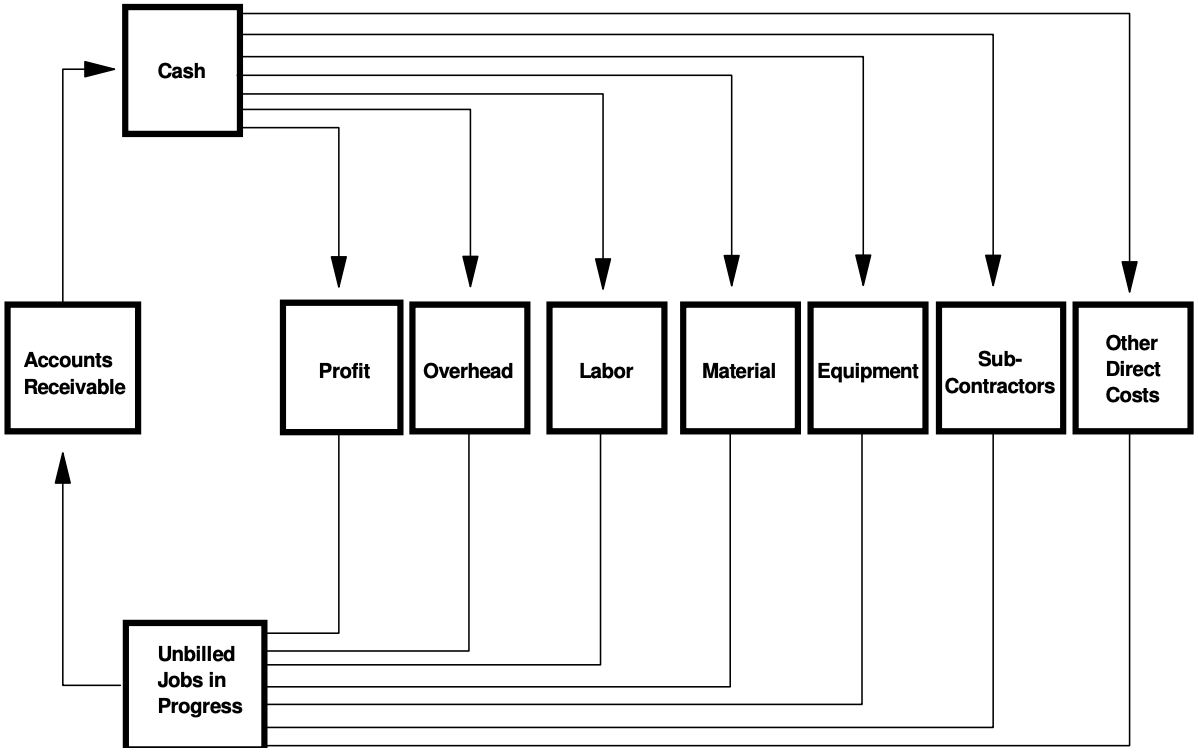
of accounts receivable, accounts receivable retention, and under billings and subtracting the sum of accounts payable, accounts payable retention, and overbillings. The resulting sum is the amount of money you have tied up in work in progress. Divide this number by the average daily revenue and you have Cash Demand Days. Improving cash demand days by just a few days can free up significant resources. For example, if you are a $10 million contractor and your cash demand is 30 days, you have $822,000 tied up in work in place. ($10 million/365 x 30). Reducing cash demand days by just three days would free up $137,000 that could fund improvements to your business.
Measuring important financial ratios on a monthly basis and trending these scores will help you recognize potential cash flow problems and take corrective action before it is too late.
Techniques to Improve Cash Flow
Since up to 85 percent of all cash in a construction company comes from project work in progress, positive company cash flow results from positive project cash flow. Project Managers are the front line of cash management. The greatest impact you can have on cash flow is to train your project managers on good cash management practices and hold them accountable for delivering positive project cash flow using the following techniques.
Schedule of Values
Frontloading is controversial topic in the contracting world. Often we ask our clients’ project managers how much they frontload their schedules of values. They respond with a smile and a wink “as much as possible.” Unfortunately, a non-standardized approach like this can lead to undesired results. Front load too little and you can find yourself financing the entire project. Frontload too much and you can unbalance your schedule making it difficult to justify billings or support subsequent change order pricing. Here are some guidelines on schedule of values:
• List measurable activities and do not use lump sum billing, as you will only be able to bill when the
entire activity is completed.
• Breakout startup activities including mobilization, submittals, detailing, and prefabrication in your schedule of values. You incur costs for these activities often before arriving on site and should be paid for them.
• Review the schedule for sequencing and list your activities in the order that they occur.
• Break out large system and material packages into separate billing categories so you can bill these items prior to completion of installation.
• Assign value to each activity. Labor cost should be accurately represented in each activity. Other direct costs, overhead, and profit can be allocated in a manner to facilitate positive cash flow as soon as possible in the project cycle.
• Providing your project managers with a Schedule of Values tool that allows them to allocate cost, overhead and profit to each activity in a traceable format, enabling you to review and hold them accountable for achieving positive cash flow as quickly as possible. Set a measurable goal for them, for example, positive cash flow by 25 percent project completion.
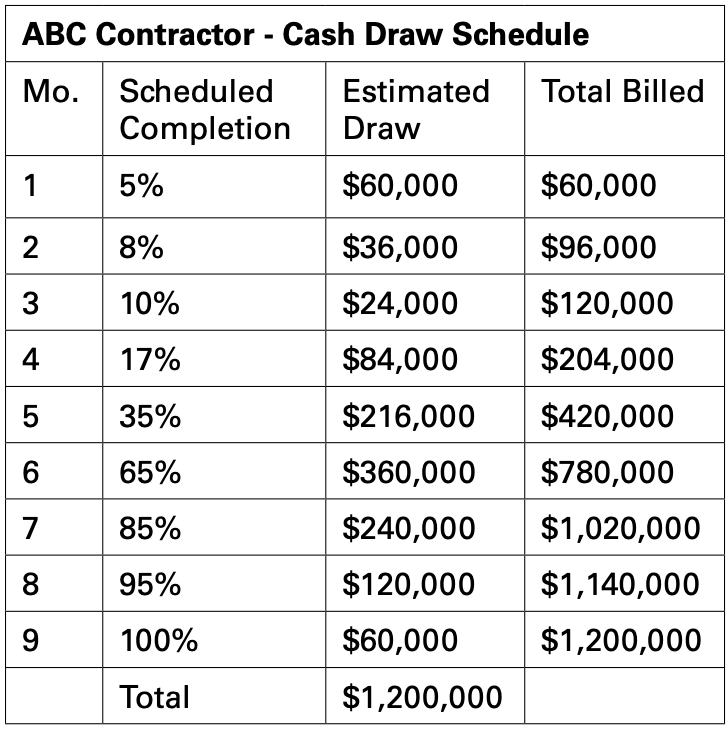
• Provide your customer with both a Schedule of Values and a draw schedule. This will facilitate easier billing and allow your customer to plan for their cash outlays.
Sample Draw Schedule
Billings
Billing, like Schedule of Values’ creation, should be a standard process with specific, measurable goals.
The PM can be given a set goal, for example, invoicing 110 percent of accrued revenue (cost+ overhead+ margin). Specific billing steps should be tied to a monthly accounting calendar and include:
1. Review existing job costs including labor, material, other direct costs and overhead.
2. Identify additional costs that will be incurred before the end of the month, especially any large material or equipment deliveries.
3.Evaluate percentage completion of overall budget. Based on total completion, establish target total billing.
4. Identify percentage complete for each schedule of value activity.
5.Compare total amount billed to target total billing.
6.Submit invoices and follow with a phone call to ensure bill has been received and is in the proper format.
Collections
Collections should be the project manager’s responsibility, not your accounting department’s The PM is the one who has the best relationship with your customer and has the most information about the project so they should be the one to resolve any billing issue. When payment is delayed it is usually for these reasons:
• Lack of agreement about percentage completion.
• Lien releases missing.
• Lack of documentation.
• Submitted after the monthly deadline.
Typically a phone call with some follow-up work can resolve most of these issues. Further delay could be a sign of defective work, a pending bankruptcy, or other legal action. Companies should have a progressive escalation policy tied to an account’s aging report that elevates unpaid invoices based on days outstanding. Anything over 60 days should receive management attention and action. Invoices out 90 days or more should receive executive attention and more severe remedies should be considered including work stoppage, filing liens, or litigation.
THE CONTRACTOR’S COMPASS JULY 2014
© 2026 Maxim Consulting Group. All Rights Reserved.
