
Using Technology as a System of Engagement
by Brian Chickowski
One of the most difficult issues that plagues contractors of all sizes and trades these days is the lack of a tool to monitor the labor production of a project while it’s being constructed.
On a typical construction project, labor contains the most risk of any cost type and is typically 30 percent to 40 percent of the total construction budget. Yet, most contractors do not have any tools in place to monitor the labor being expended on their projects.
All too often, the field staff is provided with a set of construction drawings and a “Go Build It” directive and then criticized by upper management when the project finishes over labor-budget. In reality, the project staff was not provided with any tools to monitor the labor
being consumed on the project and had no way to ensure that the project is kept on budget. The tool that is lacking needs to put a spotlight on any labor deficiencies so that they can be identified and corrected as the tasks are being performed on a weekly basis and not when the job has run over budgeted hours. Bestin-Class contractors develop, train to, and have the discipline to require the use of a Production Tracking System by their project teams and review the feedback it provides regularly to assure project success and accurate labor forecasting.
A successful Production Tracking System contains three distinct work steps, but the foundation is a construction budget that is broken down into standard repetitive task
codes and then organized by phase and geographic work areas that allow for easier time and quantity tracking at the field level. An example being a budgeted cost code identified as A1-1234.
This cost code tells the employee where and what task is being performed on the project. In the example of A1-1234, the cost code is broken down into a phase, “A” with a description of “Building A”, a work area “1” with a description of “1st Floor” being the first floor of a multistory building and lastly the repetitive task code “1234” with a description of “Install 4” PVC Conduit.” There most likely will be multiple phases and there certainly will be multiple work areas, however, the work tasks will always be the same no matter what
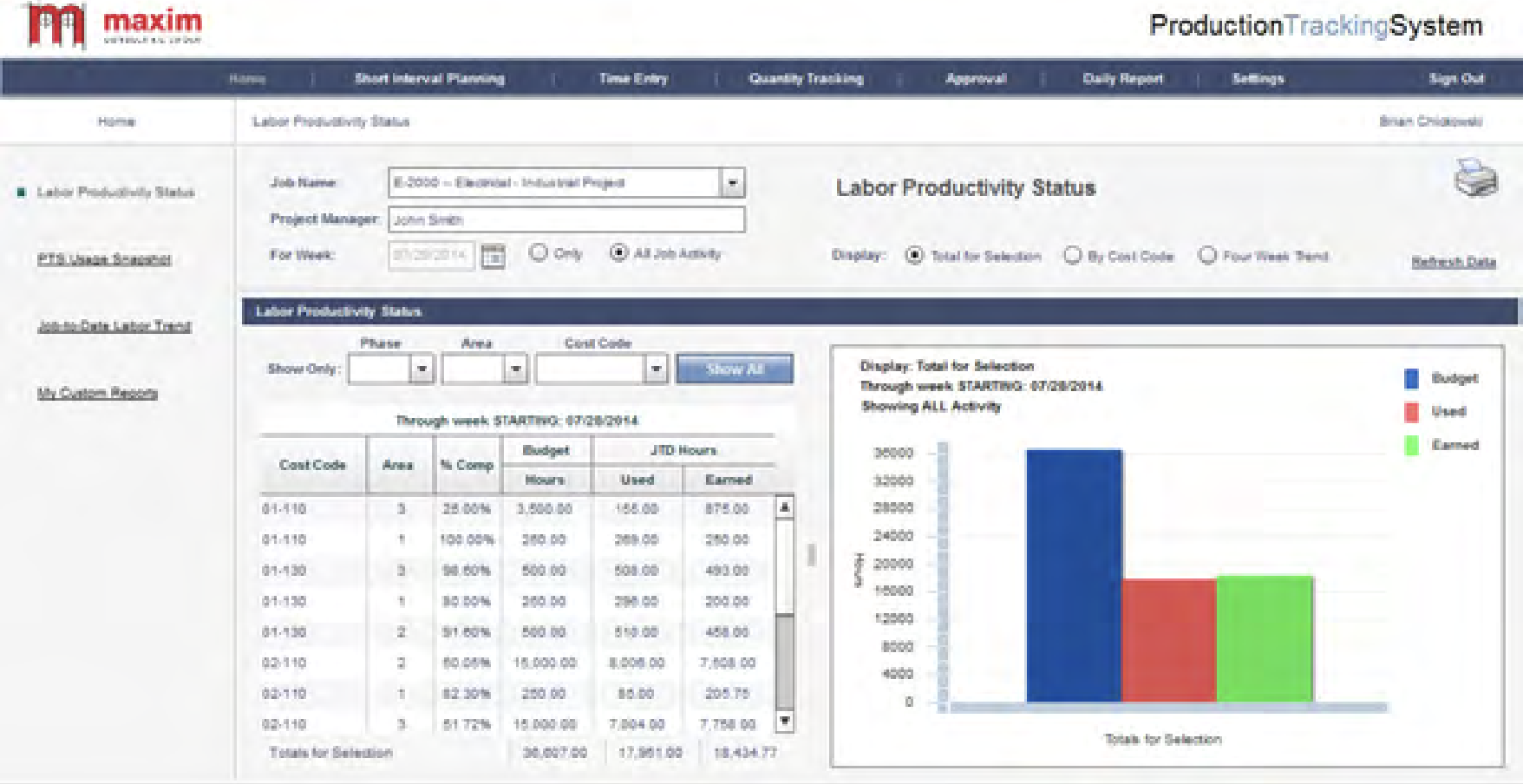
Figure 1 — Production Tracking System
SEPTEMBER 2014 THE CONTRACTOR’S COMPASS
the project that is being constructed may be. Best-in-Class contractors establish their construction budgets so that no single phase/area/task code contains any more than 5 percent of the total labor budget. If a construction budget has 5,000 labor hours, no single phase/area/ task should have more than 250 labor hours.
A Production Tracking System (see Figure 1) can take on many forms. It could be sophisticated Internetbased software that is linked directly to the accounting/ERP software of the organization that handles all three work steps and returns the time card and quantity data weekly to the accounting/ERP software for automatic processing. Or it can be a manual process of completing spreadsheets for all three work steps that make up the Production Tracking System, which are manually entered into the accounting/ERP system for processing. Either way, feedback is necessary to assist the project staff with keeping the project within or beating budget.
The first step of a Production Tracking System is a Short Interval Plan, or as most in the construction industry are familiar with, a threeweek look ahead. It allows the field
staff to plan their work for the next three weeks and puts visibility on manpower needs of the project as well as the availability of materials and equipment required by the field work force to perform the planned tasks. The goal of the plan is to minimize recoverable lost time and to ensure that there are no obstacles, such as an RFI that requires an answer, which may be preventing the field from completing the planned tasks. Project Managers should review the Short Interval Plan with the field staff on a weekly basis and address any hindrances to the field staff in accomplishing their plan.
The other key component to the Short Interval Plan is its ability to provide the field work force with quantifiable production targets to achieve on a weekly basis. These production targets are based on budgeted units of production and the man hours the field staff intend on expending during the week on the planned tasks. This budgetary production target is produced by multiplying the total hours planned on a cost code by the budgeted production rate. As an example, if the production rate for wire terminations is 5 per hour and the field is planning on having two employees work on
terminations for four hours each during the week, the production target is 40 terminations (5 per hour x 2 employees x 4 hours worked each).
The second step of a Production Tracking System is nothing new and occurs with every contractor performing work today. It is capturing the labor hours actually worked on the project on some form of a time card on a daily basis as the work is performed by the field staff (see Figure 2). While an ideal time card self populates with the cost codes that were included in the Short Interval Plan, it also needs to have the flexibility to allow for time to be charged against tasks that were not included on the planned work activities. These cost codes need to be identified in some way to provide feedback to the project team that the work that was actually performed by the field staff differed from the planned work activities. Depending on the cause of the variance in work performed in relation to the work planned, the project team must determine if there is justification to produce a request for equitable adjustment to the client if the cause was influenced by others such as out of sequence work.
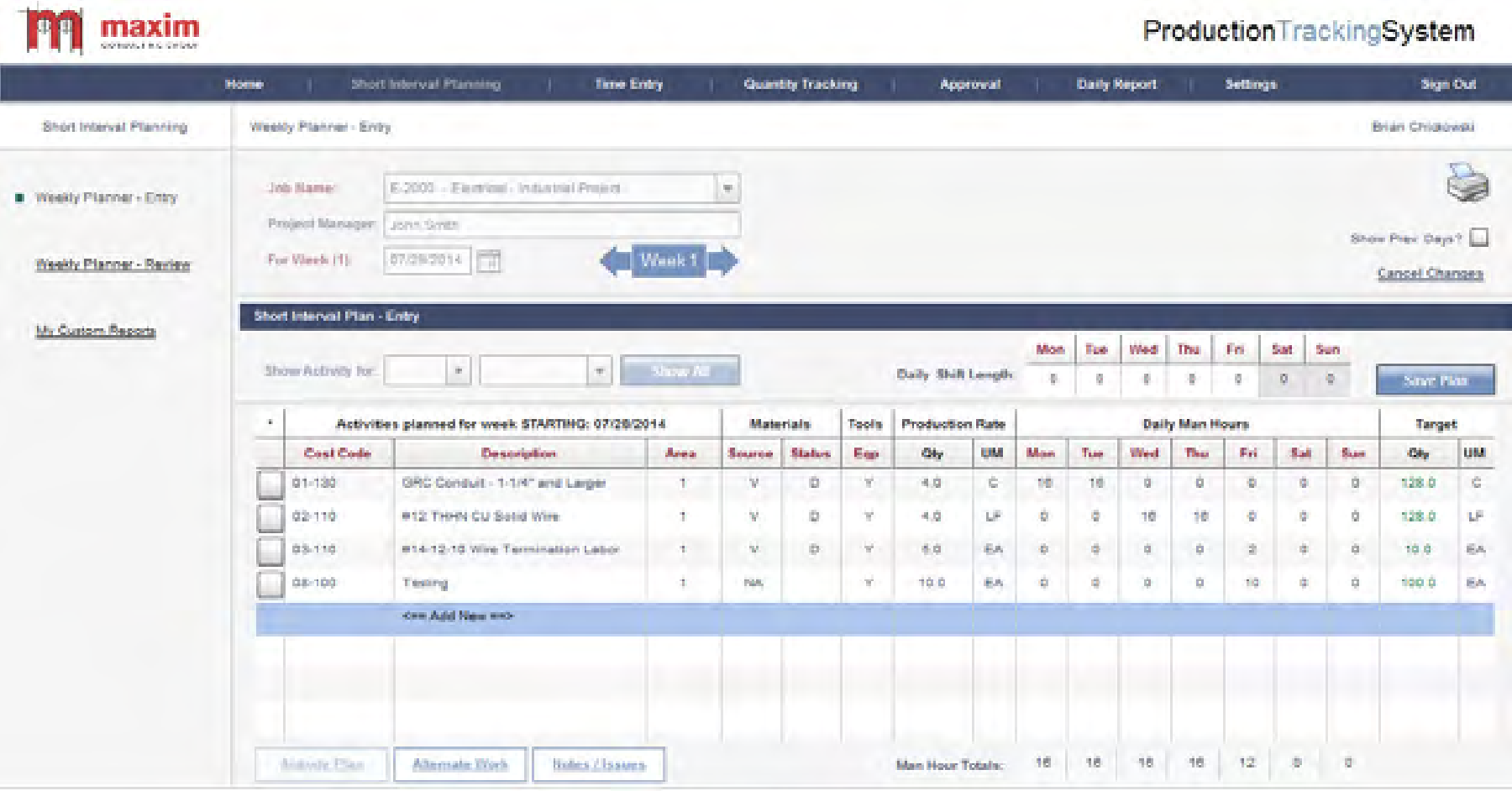
Figure 2 — Capturing Labor Hours
THE CONTRACTOR’S COMPASS SEPTEMBER 2014
© 2026 Maxim Consulting Group. All Rights Reserved.
