BY STEPHANE McSHANE
Improve Project-Level Cash Flow with
Training & Education

BY STEPHANE McSHANE
Improve Project-Level Cash Flow with
Training & Education
For those who have occupied the seat of CFO, controller, or accountant, knowing the importance of cash flow is elementary. But, does that same level of financial aptitude flow throughout your organization?
Many companies struggle with creating a culture that stresses the importance of cash. The processes and metrics that drive accountability to those responsible for its timely collection are rarely in place. With the growth potential coming out of the recent economic downturn, cash is more important than ever. The risks associated with growth are real, and your current cash position is a direct indicator of how rapidly growth can occur. How can your company effectively mitigate the risks of growth?
This article will review the basics of cash flow and ratios, as well as the tools and techniques used to ensure proper cash flow at the project level.
Cash Flow Basics
In simple terms, cash flow equals cash receipt minus cash payments over a given period of time.
Cash flow problems do not simply appear without warning, so regularly review the following baseline items:
• Working capital should be in the range of 7-12% of revenue
• Current ratio at 1.5 x or greater
• Quick ratio at 1 x or greater
• Overbilling at net 10%
• Projects cash positive at 25%
• Debt to equity 2.5 x or less
Despite the importance of a company’s cash position, few take the time to produce a statement of cash flow each time that the balance sheet and income statement are produced. Fewer still produce cash flow projections based on their WIP reports. Both of these should be produced and reviewed regularly as key performance indicators (KPIs).
While monitoring cash flow at the corporate level is certainly a critical tool, a more proactive approach to managing cash can be found at the project level. In order to accomplish this, financial training must be provided to the employees who can effect the greatest change – your project team. When examining the types of fiscal responsibility that are bestowed onto your PMs, you must also examine the tools that they have been provided to most effectively do their job.
Schedule of Values
Do your PMs understand the impact that the schedule of values has on their project cash flow and the cash flow of the organization (whether negatively or positively)? In many companies, little attention is paid to the schedule of values that is generated by the PM, which creates an enormous missed opportunity.
To ensure that the ability to be cash positive earlier in the project exists, financially savvy companies should require the use of a standardized process (including an executive review). As with any process, it is critical that the PMs understand the big picture and their role in it. It is typically their responsibility to obtain approval of the schedule, so the road map must be clearly set. The motivation should not be for them to throw it together and get it off their desk quickly, but rather to define a revenue recognition strategy that ensures a good cash position for their projects.
Billing
Billing strategies can often be a challenge for many contractors. To ensure that billing occurs timely and accurately, define your billings process as follows:
• Review the existing costs for labor, material, and direct job items.
• Identify additional costs to be incurred prior to month’s end.
• Evaluate the percent complete of the billing item.
• Mark up each corresponding billing item with a predefined minimum percent (usually around 20%).
CFMA Building Profits July/August 2014
accounting & REPORTING
• Verify that the total billing amount meets or exceeds the following equation: (percent complete x contract amount) + 20% of cost
• Meet with the client to ensure that he or she understands and agrees with the billing and amount. This prevents a tremendous amount of rework and confusion when billings are rejected and must be recalculated.
• Ensure that all required documentation has been submitted as required by the contract.
Collections
Collecting the billings is often perceived by PMs as the responsibility of the accounting staff. However, best in class contractors understand that PMs are critical to the collections process and should have a clearly defined role in the collections strategy.
In the past year, how many of your company’s billings were rejected? Of those rejected, do you know the reason? Many times, the reason is simple and often caused by something that was overlooked. A defined process would ensure that items such as lien releases, preapproval of billing amounts, required documentation, closeout documentation, and timely submissions are routine. Each billing rejection adds an additional cycle in between the time billing is submitted until it is collected.
There is often a culture clash between accounting and operations when it comes to collections processes. However, if the work steps are defined and assigned to the appropriate person, the potentially adversarial relationship tends to dissipate, leaving timelier collections and better cash position.
Sample Cash Flow Analysis & Alternatives
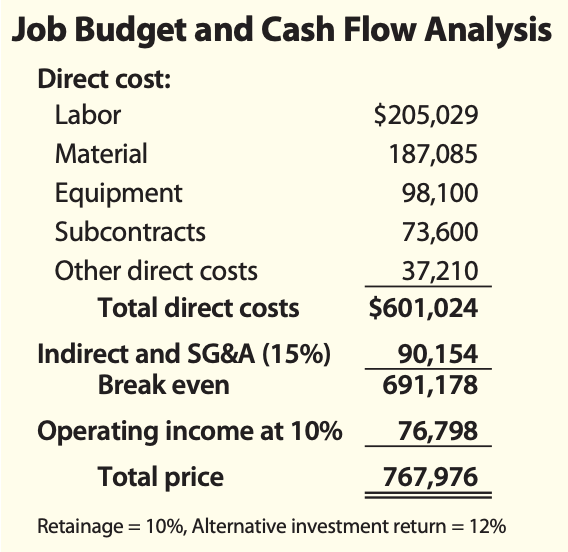
In order to add some context behind the need for proper collection practices, let’s explore a sample project budget with all of its direct job costs, indirect and SG&A costs, and operating income.
It is important to note that there is a 10% retainage requirement on this project. Using this example,
let’s explore how the cash position is impacted by 30-, 60-, and 90-day payment terms.
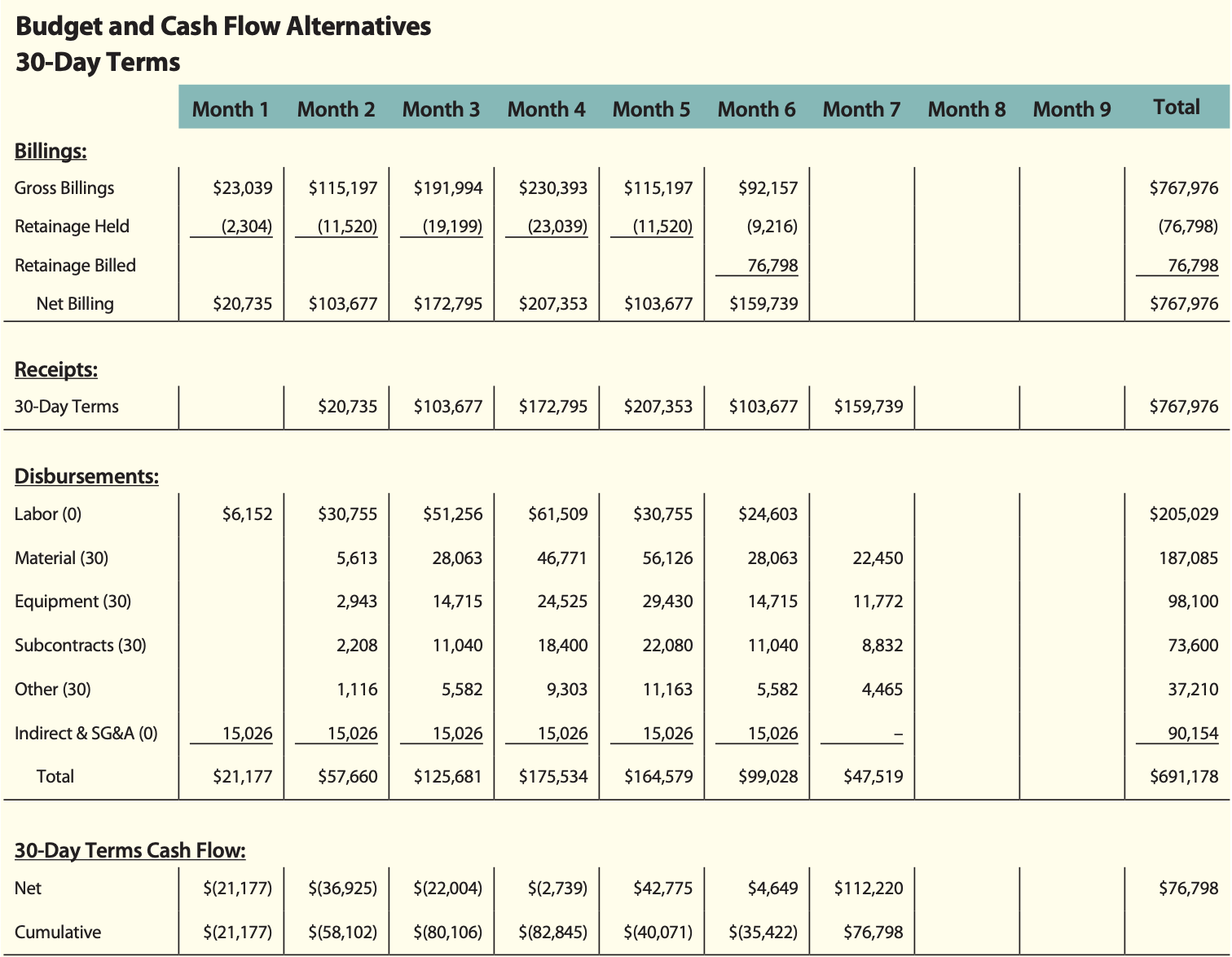
In this 30-day term example below, you can clearly see the billing amounts in the top section, receipts and disbursements in the center sections, and the cash flow analysis in the lower section. Even with fairly aggressive billing in the second and third months, this project does not become cash positive until month seven – one month after work on the project has been completed. This is only the case if your project’s days sales outstanding (DSO) are 30 or less, which is tremendously rare in today’s financial climate. It’s also worth noting the maximum out of pocket amount of $82,845 in the fourth month of the project. Remember, this project’s
July/August 2014 CFMA Building Profits
total revenue is only $767,976 with operating income of $76,798.
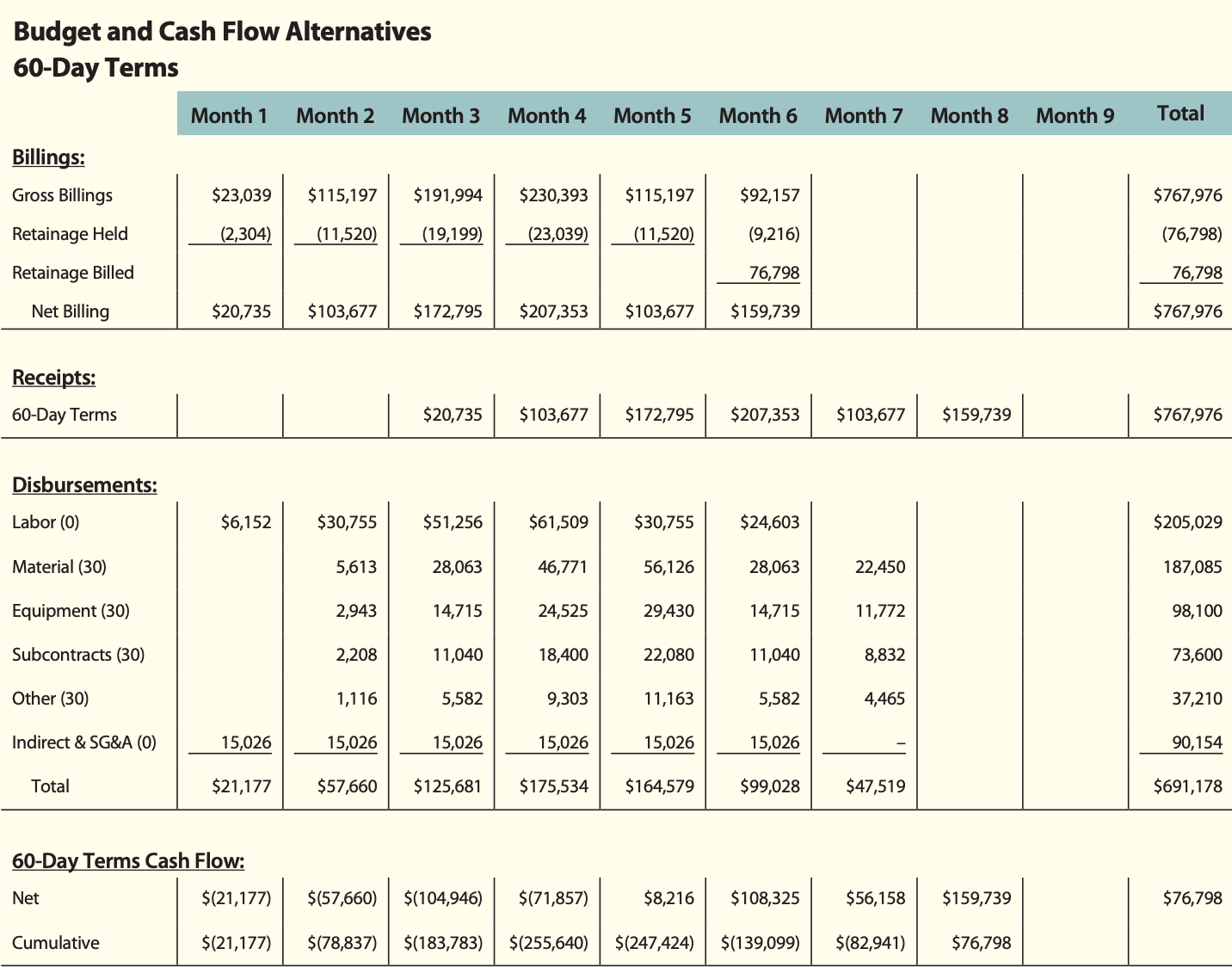
Let’s look at this project with the same billing amounts and disbursements, but with a 60-day payment term (which is much closer to reality for many contractors).
It should raise some significant alarm that the project does not become cash positive until two months after the work is completed. The maximum out of pocket expense is now $255,640 (i.e., you need to have this available in order to finance the project). Remember, the total revenue of the project is only $767,976 with operating income at $76,798.
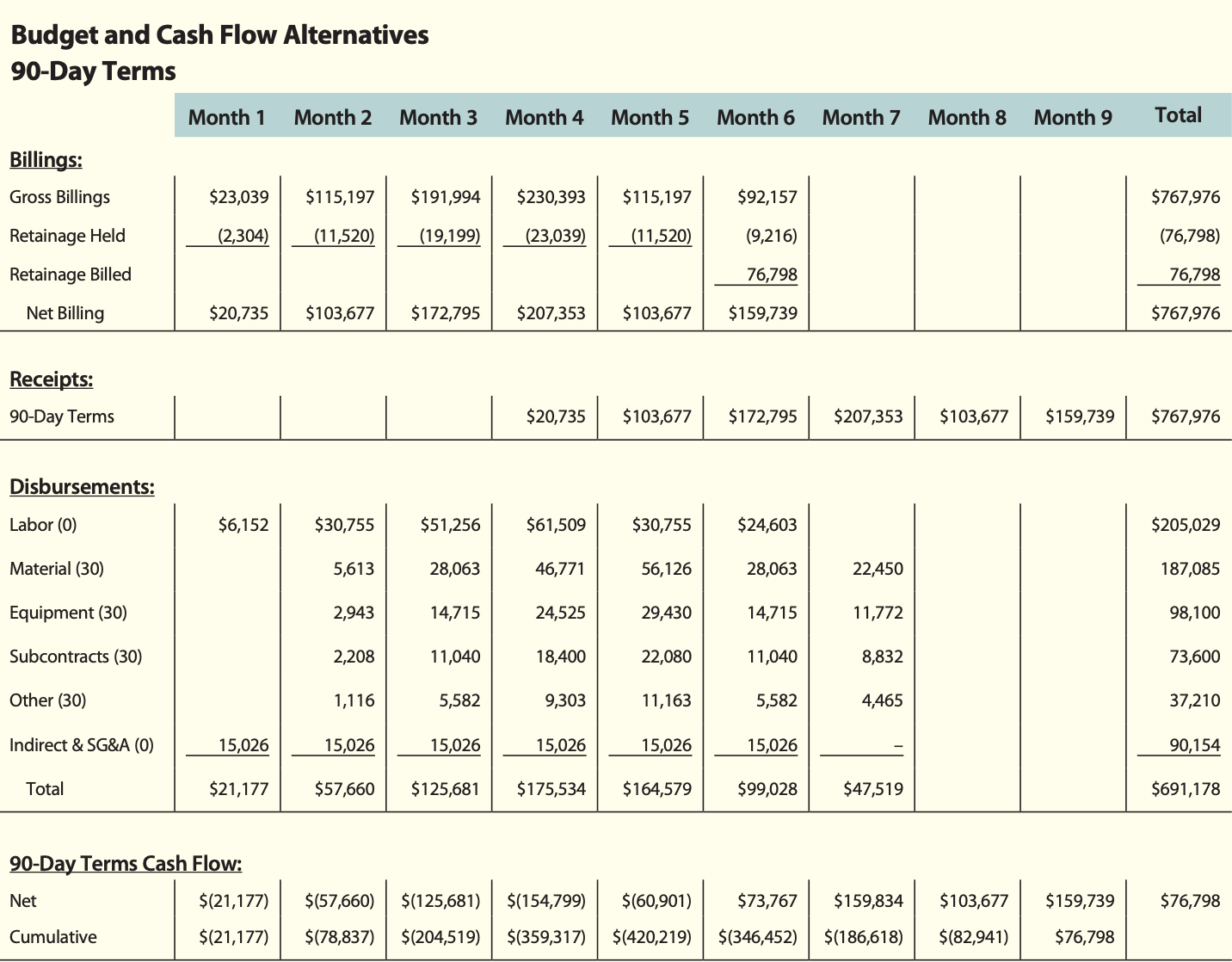
Finally, let’s run this same scenario with a 90-day payment term. Ninetyday terms are a reality for many contractors. In this scenario, the project does not become cash positive until three months after completion of the work. And, the maximum out of pocket to finance this project is $420,219 – almost 55% of the total contract amount and five times the amount of the project’s operating income. Unfortunately, a DSO of 75-80 days is not uncommon for many companies, yet it has a tremendous impact on the cash flow within the organization.
While all of this information is troubling, there is one additional consideration: What does this cost your company? If we assume a weighted average cost of capital of 12% due to the higher than average risk associated with construction, we can place some values on these scenarios. Looking at the 30-, 60-, and 90-day payment terms, the costs associated with performing these projects can be shown at the top of the next page.
CFMA Building Profits July/August 2014
accounting & REPORTING
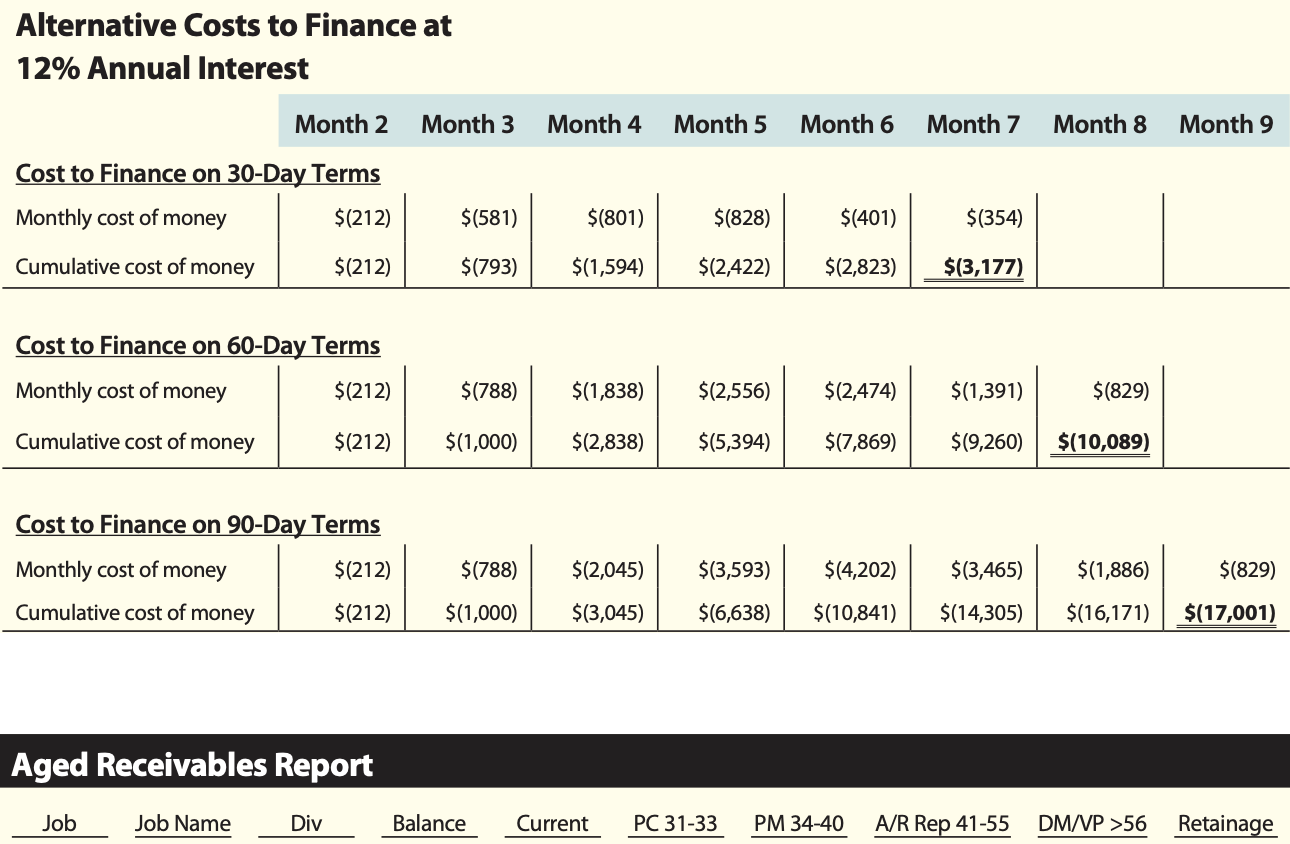
The project with the 30-day terms costs a total of $3,177; 60-day terms cost $10,089; and 90-day terms cost $17,001. Would the current market support these projected costs in your bid? In most regions of the country, that answer would be no. So, we must focus on those items that we do have control over, such as the schedule of values, billing, and collections.
Educate Your PMs
A strong collections strategy is the gateway to collecting your cash more efficiently. Most companies publish an aging report. But what do your PMs do with the aging report?
An internal escalation process guided by an aging report can help define the roles of who handles the collection of an account at what time during the aging process. This allows for the proper level of authority to be addressing the issue at the right time, thus driving a quicker turnaround on receivables.
An example of an aging report header is shown above. Notice that there is a responsible party associated with the collection activity at each defined break point in the aging report. In this example, at the 31-33 day mark, the project coordinator is responsible for the account. From 34-40 days, the PM should be calling and requesting the status of payment. From 41-55 days, the A/R representative takes over, and on the 56th day, the division manager or vice president takes over collection activity.
While this report may look different in your company, having defined roles and timing for escalation will aid tremendously in the effort to collect your receivables.
Another common area that requires more financial aptitude and training for the project team is the timing of lien rights in order to prevent the loss of rights by late filing.
Another effective process is to charge the PMs interest on projects with a negative cash position. Allow projects with positive cash position to collect interest. The DSO for each PM can also be used as a performance metric, further solidifying the importance of collecting in a timely manner. As anyone who has been in a claim or litigation can attest, the percent recovery of past due receivables decreases with time.
Conclusion
Poor cash management practices will have a direct impact on your company’s ability to grow during the current upswing. It is well worth the effort to ensure that the cash position is strong in order to drive down the cost of doing business and allow for this welcomed growth to occur. To accomplish this, financial training at all operational levels will allow your employees to understand the big picture and the important role that they play.
Structured processes around the schedule of values, billing practices, and collections protocols will allow for better predictability in revenue recognition and the help produce the ultimate goal of improved cash flow in your company.
STEPHANE McSHANE is the Associate Director at Maxim Consulting Group in Denver, CO, where she is responsible for the evaluation and implementation processes with the company’s clients.
Stephane works with construction related firms of all sizes to evaluate business practices and assist with management challenges. Stephane has authored for ASA’s Contractor’s Compass and has presented at numerous engagements across the U.S. and Canada for ASA, ABC, NECA, SMACNA, numerous builders associations, and private contractors. Her areas of expertise include leadership development, executive coaching, organizational assessments, strategic planning, project execution, business development, productivity improvement, and training programs.
Phone: 303-688-0503, ext. 706
E-Mail: stephane.mcshane@maximconsulting.com
Website: www.maximconsulting.com
July/August 2014 CFMA Building Profits
© 2026 Maxim Consulting Group. All Rights Reserved.
