

WWW.ASAONLINE.COM AUGUST 2019
How to Get Construction Data from the Field
by Nathan Snow, Content Director, Raken, Inc.
Data Distortion and Improving the Human Side of Data Collection
by Chad Pearson, Director of Business Development, Plexxis Software
Mammas Should Tell Their Babies to Grow Up to Be Plumbers
by Mike Brewer, President of ASA of Arizona;Todd Sanders, President & CEO of the Greater Phoenix Chamber; Karen Fann, President of the Arizona State Senate; and Mike Trailor, Director of the Arizona Department of Economic Security
LEGALLY SPEAKING: Cyber Crime and Terrorism Threatens the Construction Industry: Contractors Must Be Prepared
by Ross A. Boden, Senior Associate, Sandberg Phoenix
Challenges and Trends in Construction Data Collection
by Patrick Hogan, CEO, Handle
A Little Bit Ikea, A Little Bit Apple
by Gregg M. Schoppman, Principal, FMI Corporation
Data Mining—Looking Back to Accelerate Moving Forward
by Stephane McShane, Director at Maxim Consulting Group
American Subcontractors Association
1004 Duke St. Alexandria, VA 22314 www.asaonline.com (703) 684-3450 communications@asa-hq.com

American Subcontractors Association | 1004 Duke Street, Alexandria, VA 22314
(703) 684-3450 | www.asaonline.com | communications@asa-hq.com
by Stephane McShane, Director at Maxim Consulting Group
Improvements in construction software programs have allowed us visibility in transparency of performance like never before. However, many construction firms struggle with the foundational implementation steps necessary to be able to mine this valuable data easily. In this article, we will discuss what metrics might be of value to a self-performing subcontractor, how to deploy technology properly, and how to utilize this information in your strategic initiatives.
The Why Before the How
With any initiative, it is important to discuss why this is important. In the concept of data mining, the why would be to allow the stakeholders and employees to see how the organization is performing. In addition, the performance of divisions, profit centers, project teams, individual field leaders, and project managers can be viewed. These metrics can be easily tied into performance management and incentive compensation programs in order to recognize and compensate individuals and teams for the exact metrics that we are looking for them to influence.
Looking externally, having the right information in an easy to access manner would also allow a view into which markets, which customers, which job sizes, etc. your organization performs best (and worst) in. This information is critical in evaluating market opportunities and focusing efforts on strategic improvements and expansion planning.
What Information Is Important
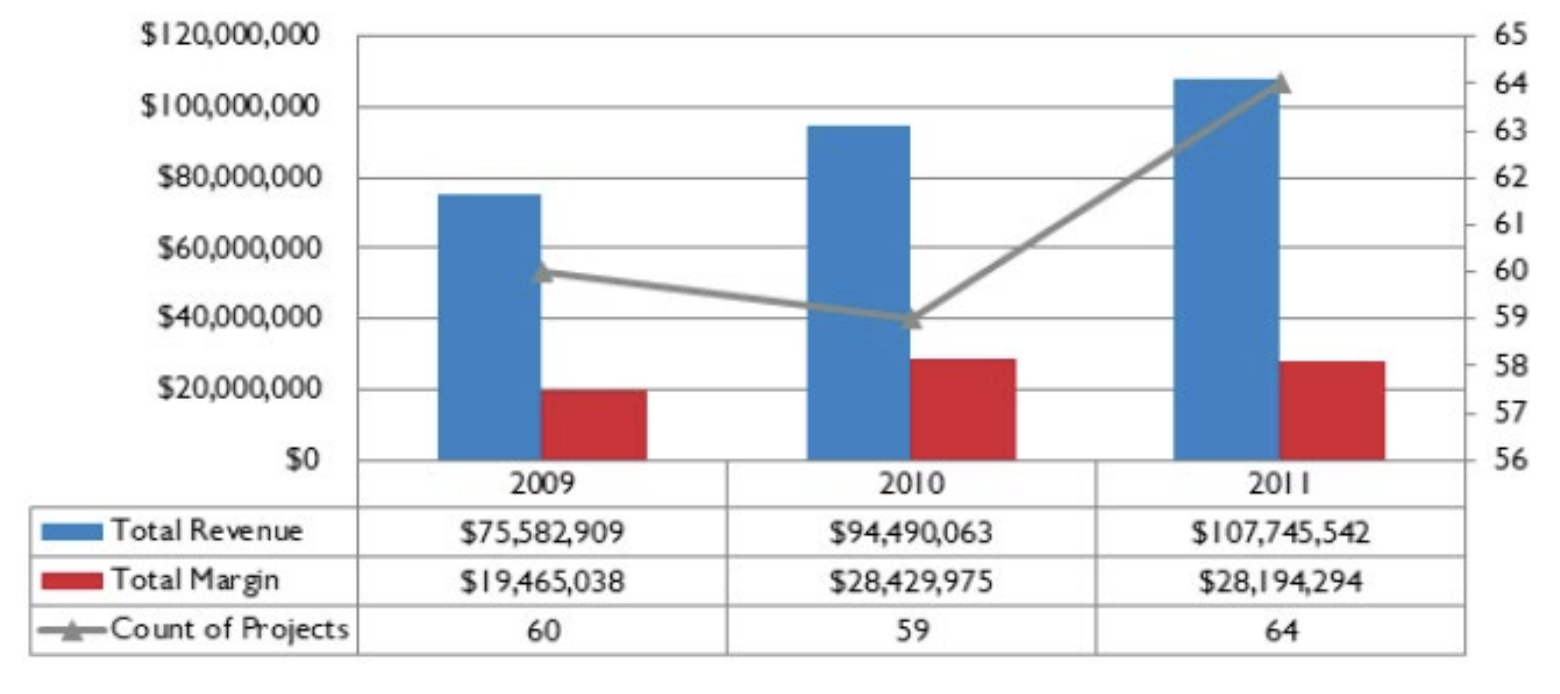
Beginning with the big picture in mind, making the determination of what information needs to be mined is critical before starting any changes. An example of a starting point is having information surrounding revenue and margin.
Looking at this type of information year after year might look something like this:
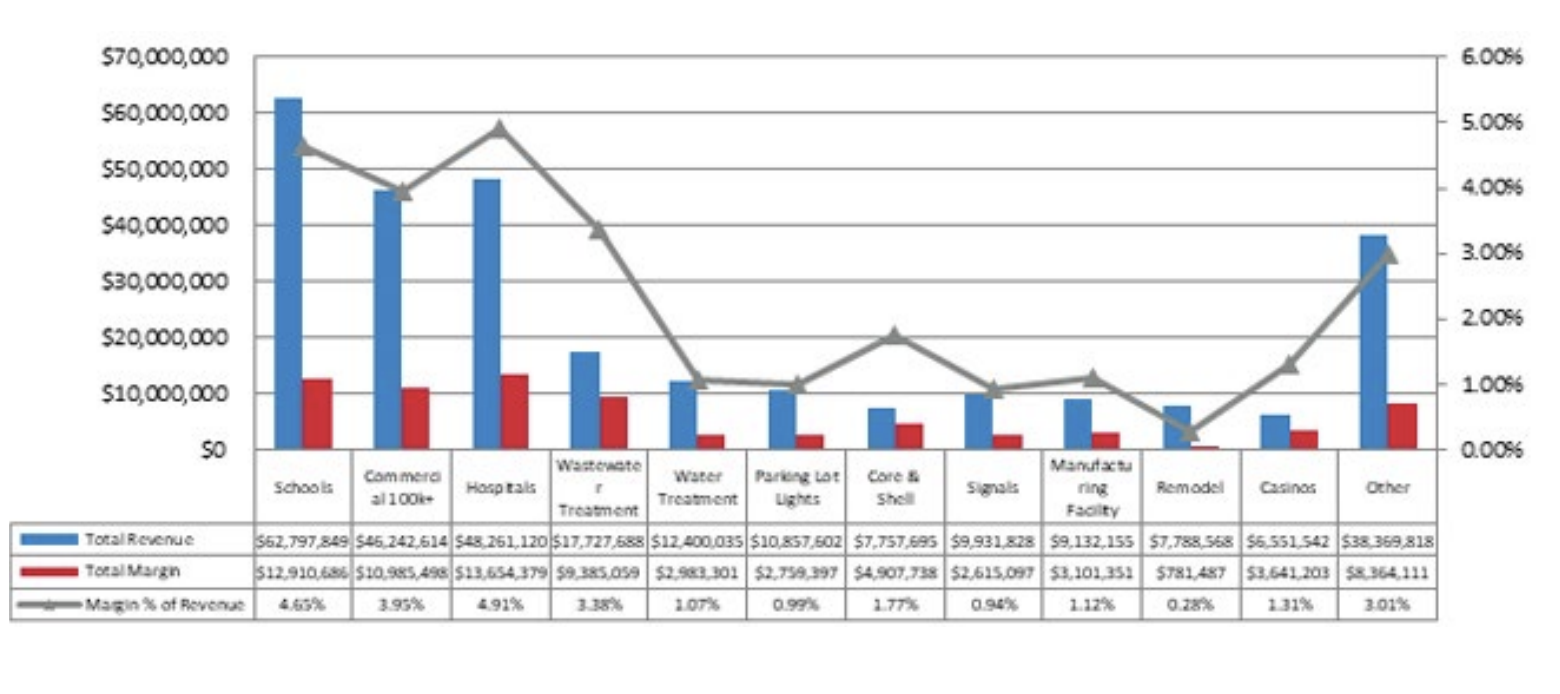
And, another view of revenue and margin by project type:
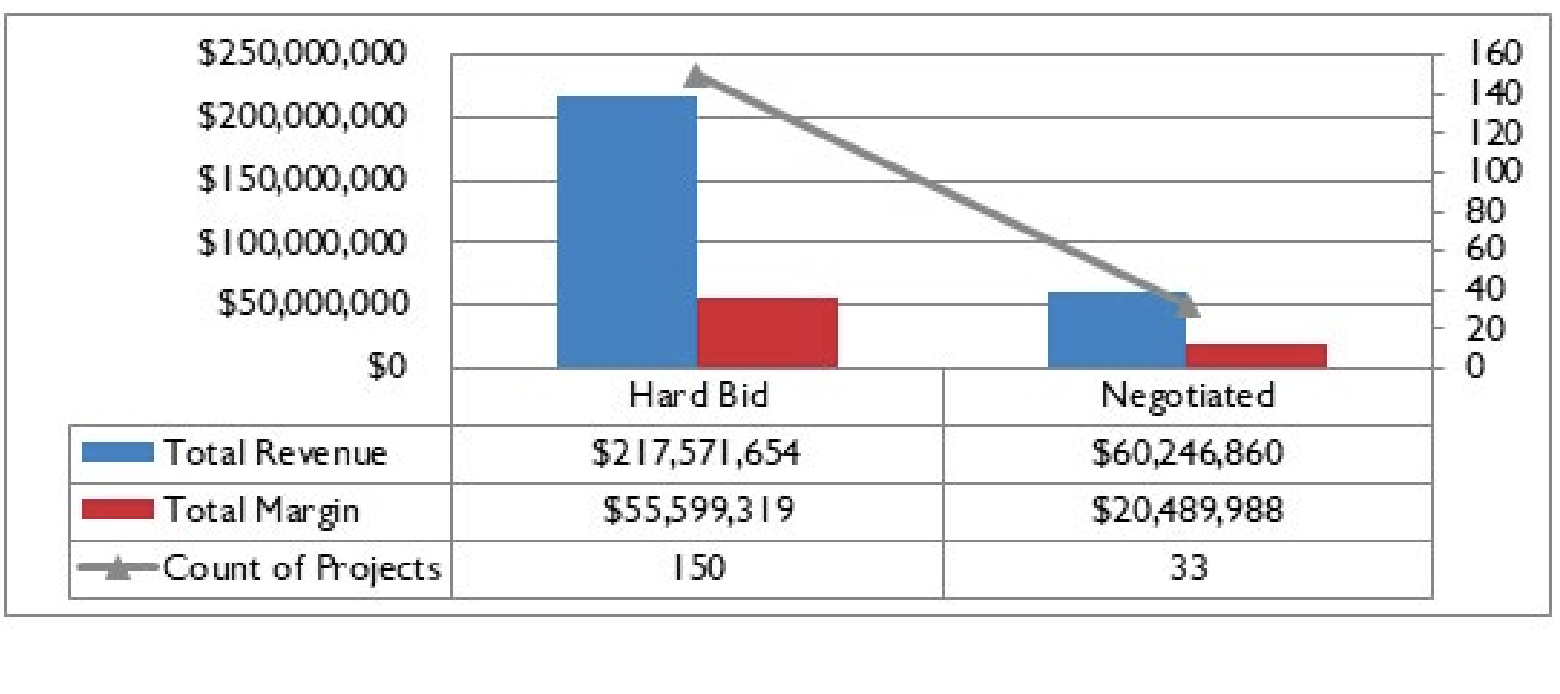
Here is some data by contract process:
AUGUST 2019 THE CONTRACTOR’S COMPASS
Other ways of reviewing revenue and margin might include such information differentiated by:
• Delivery Method
• Job Size
• Public or Private
• General Contractor or Owner
• Job Size
• Distance from the Office
This list of differentiators might vary based on your type of business, average job size, and current market position. However, taking the time to define these so that they may be utilized year after year would be of tremendous benefit.
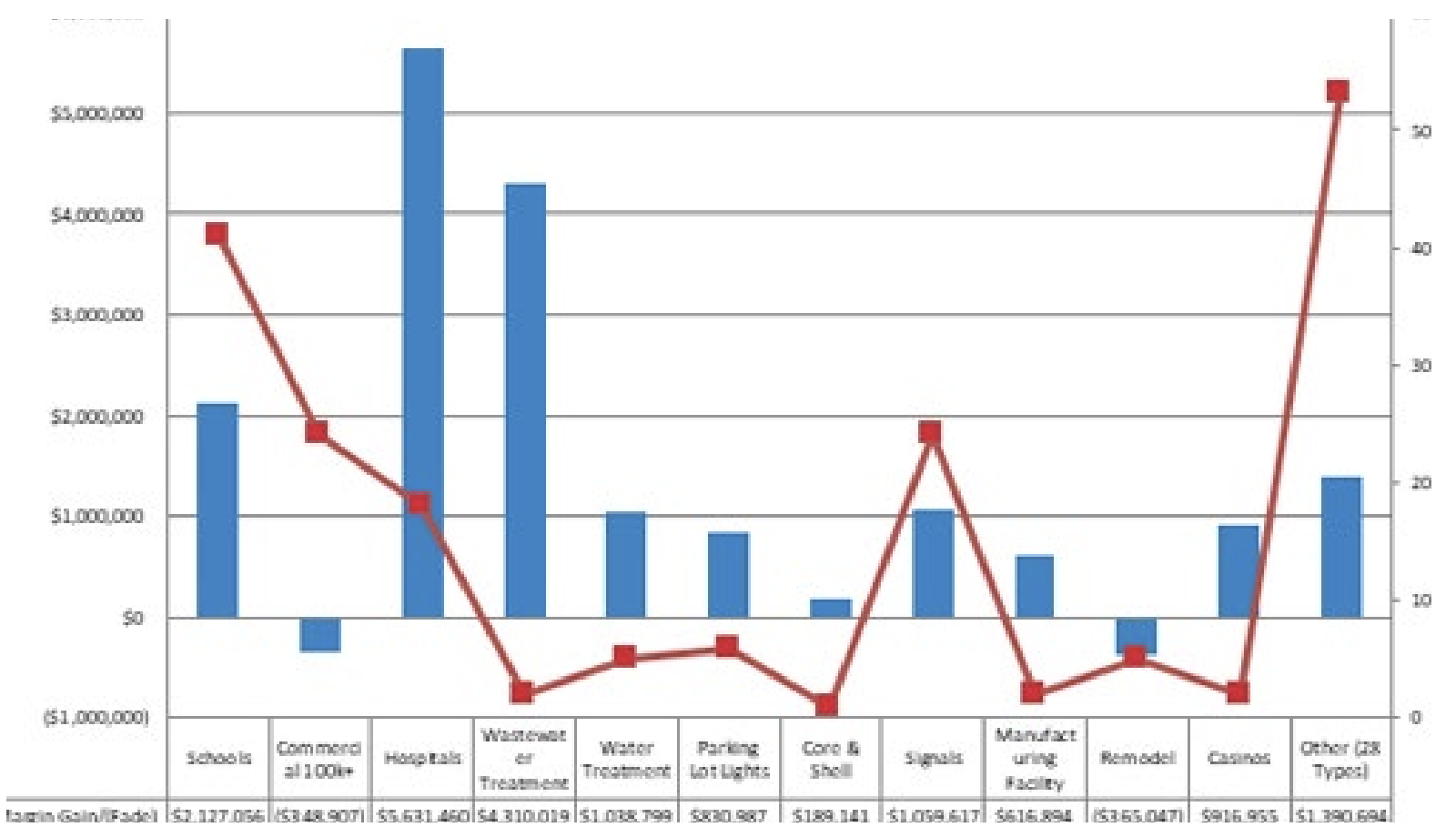
The next set of metrics that are valuable to review are margin gain and fade statistics. In other words, which jobs made more or less margin than originally budgeted. Similarly, these metrics can be further differentiated by running the data by the same types of key definitions as listed above. The below graph depicts margin gain or fade by project type. This type of information is key in making strategic decisions for your organization.
depicts labor in hard bid jobs versus negotiated jobs:
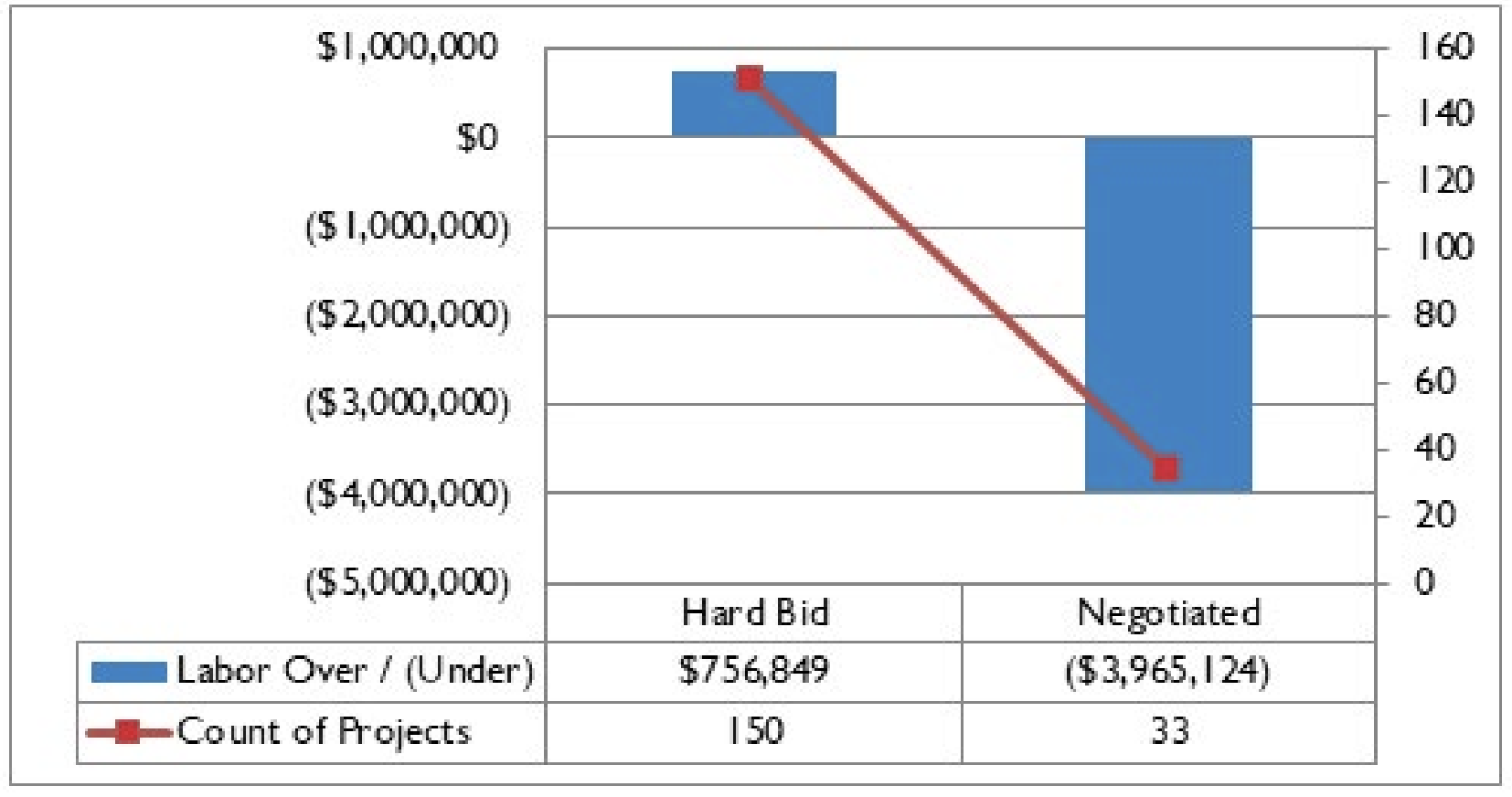
Similar analysis could be run for material, equipment, subcontracts, or other direct job costs. So, what would this type of information tell you? In essence, it would display patterns of revenue, margin and direct job costs given all of these key differentiators in order to allow a view into project performance as a whole You could similarly run this type of data by branch, profit center, division, project manager, field foreman, superintendent, and estimator as mentioned previously in order to have data to support performance management and to utilize as a basis for incentive compensation. These are representations only as there are endless combinations of information that could be set up and tracked. It is critical to determine what you want to see, then set your system up in order to be able to extract the data associated.
Proper System Selection and Setup
Many newer construction firms begin as entrepreneurships. With that said, many firms make their first selection of ERP (Enterprise Resource Planning) software based on the startup size. Once you begin utilizing an accounting system, making a change to a completely different system is painful. Many organizations stay with their original purchase for far longer than they should, restricting the amount of information that is available on the project level. The moral to the story is to assess your current technology to find out if it does, in fact, serve your needs. There could be a couple of different scenarios that could be playing out here. The first is quite common in that organizations purchase ERP systems and utilize just a fraction of what they can do. The second is that they have outgrown their current system, but are reluctant to make the switch because of the cost and difficulty in doing so.
AUGUST 2019 THE CONTRACTOR’S COMPASS
Depending on your size, your ERP system should be able to, of course, perform the core accounting functions. For firms larger than $15-20M with opportunity to grow, the generic accounting platforms will, in general, not give the functionality that you would need. In addition to the core accounting functions, you want integrated modules that would allow for items such as:
• Job cost management
• Labor tracking via phase/area/task codes
• Project Management
• Purchasing
• Subcontract Management
• Service (T&M)
There are “bolt on” programs that can perform some of these functions if your current software does not. Be aware, however, that if the platforms do not integrate, a duplicative entry would be required in order to have the information, in some form, in multiple locations. If there is a question whether your existing platform is adequate, or for assistance in deploying the technology, outsourced assistance is a safe bet. Having someone who can look at your company, determine how it functions, calculate what your average job sizes are, and define what modules you would need would be of tremendous help. Additionally, these types of resources can determine how to best capture the types of definitions that were mentioned previously, and write reports to gather the data needed to run your monthly, quarterly, or annual analysis.
Proper system setup and utilization for construction projects require definitions and standards around preconstruction planning, budgeting, purchasing, time/quantity reporting, change order management, and forecasting. The requirements for service would include definitions of project startup and reporting for both T&M and lump sum small projects. Without standards, the deployment of
technology would not cleave the type of accurate metrics and information necessary for your organization.
Utilization of the Data
Strategic planning for most construction firms begins with the understanding of which markets we wish to work in, what customers within those markets we wish to do business with, and what key differentiators make us stand out from our competition. Much of our business development planning is defined by length of sales cycle and future market opportunities. That said, making the decision on which markets, which customers, and what our key differentiators are, are heavily defined by who we have been, which markets we have been successful in, and which customers we perform the best with, which aids in determining why we are better than our competitors.
Utilizing data, we can clearly see which markets we excel in and which we struggle with. Obviously, it would be advantageous to pursue work which we are proven to be successful in. For the work that is more of a struggle, an improvement plan can be put into place to produce the margins desired, or a decision can be made to reduce or eliminate those sectors. Setting financial metrics for estimators, project managers, division managers, and executives begins with an accurate picture of past performance aligned with a clear expectation of future performance. Couple this with skill set metrics, and you have the ability to create a performance management and incentive compensation model that is truly effective, creating a pull effect that the employee owns due to its transparent nature. This type of information is highly effective to managers in identifying future leaders as well.
Summary
Data mining is a practice that has been utilized in industries such as
manufacturing, retail, and others for many decades. While its utilization in the construction industry is growing, there are still many organizations who do not have the level of information and transparency needed to drive excellence. Knowing where you are today, and having a clear picture of where you want to be is just the beginning. The real rewards are reaped when the right information is given at the right level of the organization, to those who can truly impact the financial outcomes of projects. Whether it is the deployment of standard dashboards, monthly job cost reports, labor productivity information, margin/revenue/direct job cost metrics, information is the driver of both awareness and improvements. No longer can we work in the cone of silence. Our highlevel performers demand more information than ever to provide them greater opportunity to excel. As construction leaders, it is our primary job to listen to what our teams need, then commit and execute on those needs.
Stephane McShane, Director at Maxim Consulting Group, is responsible for the evaluation and implementation processes with our clients. Stephane works with construction related firms of all sizes to evaluate business practices and assist with management challenges. With a large depth of experience working in the construction industry, Stephane is keenly aware of the business and, most specifically, operational challenges firms’ face. Her areas of expertise include: Leadership development, organizational assessments, strategic planning, project execution, business development, productivity improvement, and training programs. Mrs. McShane is an internationally recognized speaker, mentor, author, and teacher. Her ability to motivate, inspire, and create confidence among your work groups is extremely rare and very effective. For further information visit http://maximconsulting.com/
AUGUST 2019 THE CONTRACTOR’S COMPASS
© 2026 Maxim Consulting Group. All Rights Reserved.
